
Let's settle this debate properly.
Because if you've been in CPA for more than five minutes, you've heard this question before.
When affiliates compare PIN API and mVAS (S2S), they usually ask the wrong questions:
''Which one converts better''.
It sounds logical. It's just incomplete.
That's like asking whether a manual car is faster than an automatic.
It depends who's driving.
It depends what road you're on.
And whether you actually know how to use the gears.
The real question is:
Do you want speed.. or control?
Because both models can scale.
And both models can burn your budget if you treat them the same.
The mistake isn't choosing the wrong model. It's using the wrong approach.
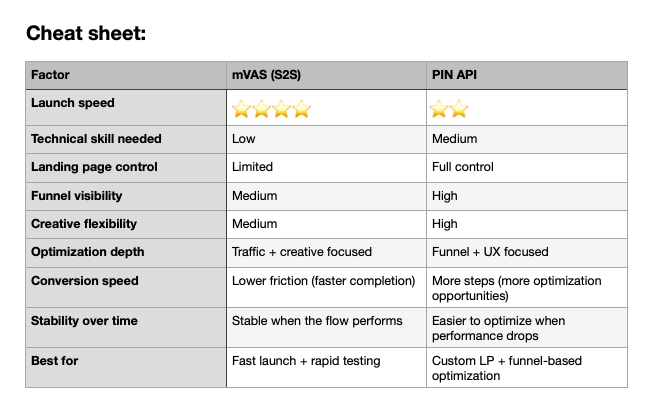
The core difference (in one sentence)
mVAS (S2S):
You send traffic to a fixed subscription flow and track conversions server-to-server.
PIN API:
You run the same PIN mechanics, but you integrate via API and build the landing/subscription page yourself.
Same mechanics. Different ownership.
1) Setup & launch speed: plug & play vs build & optimize.
mVAS (S2S)
With most mVAS offers, affiliates typically:
- Send traffic to a fixed LP/subscription page
- Optionally use a prelander
- Track conversions via S2S
- Optimize mainly through: creatives, targeting, placements, traffic source strategy
Big advantage?
You can launch fast.
This makes mVAS perfect for:
- Quick testing
- Aggressive scaling
- Affiliates who want minimal technical overhead
PIN API = Build & Optimize
PIN API offers still follow the classic PIN flow:
MSISDN -> PIN request -> PIN submit -> confirmation
Nothing exotic.
The difference?
You host and design the page where the subscription happens.
That means:
- You need some technical skill (or a dev)
- But you gain the ability to test and optimize the subscription experience itself.
PIN API is for affiliates who think:
''What if i could improve the funnel itself?''
2) Landing page control: fixed vs custom
This is where things get interesting.
With mVAS (S2S):
- The final subscription page is fixed
- The UX and layout are predefined
- Your optimization happens ''outside the LP''
This is not a downside, it's a trade-off.
You get:
- Stability
- Simplicity
- Speed
Which is why many affiliates scale very well with it.
With PIN API:
You can build a custom LP that matches your traffic.
You control:
- Layout
- Messaging
- Localization
- UI choices
- How steps are presented
- Friction management
Same PIN mechanics.
Different experience.
And in CPA, experience is leverage.
Because small improvements don't feel small once you're running volume.
Think of it like this:
Traffic is fuel.
The funnel is the engine.
mVAS lets you step on the gas.
PIN API lets you tune the engine.
And when your engine becomes more efficient,
You need less fuel for the same output.
Which means better margins without necessarily buying more traffic.
Oh and bonus:
You're not sending traffic to the same standardized page as everyone else.
That doesn't eliminate competition.
But it does reduce ''cookie-cutter'' saturation.
And in competitive GEOs, that difference matters.
3) Funnel visiblity: surface data vs deep data.
This is the biggest practical difference for serious affiliates.
Especially once you start scaling beyond ''test budgets''.
mVAS (S2S):
With mVAS, you usually see:
- Clicks
- Conversions
- Postback results
But you don't always see what happens inside the subscription flow.
So when performance drops, you're often left with questions like:
- Did users even reach the subscription step?
- Did they drop off on the page?
- Was there a technical issue?
- Did the carrier reject it?
- Were they already subscribed?
In other words:
You see the outcome
But not the full story behind it.
That's why optimization in mVAS is often:
- Traffic-driven
- Creative-driven
- Experience-driven
Which can work very well, but it's not always surgical.
PIN API:
With API integration, you can get much deeper funnel visiblity.
Not just ''did it convert''.. but where did it break?
For example:
- Did the click become an LP visit?
- How many users reached the MSISDN step?
- How many submitted a phone number?
- How many requested a PIN?
- How many entered the PIN successfully?
- Where did users fail, and why? (e.g. insufficient balance, already subscribed, wrong MSISDN, wrong PIN)
Now you're not optimizing based on assumptions.
You're optimizing based on diagnostics.
4) Which model fits your traffic?
Here's a simple decision model.
Choose mVAS (S2S) if you want:
- Quick set up
- Fast testing cycles
- Plug and play scaling
- Minimal technical work
- A clean focus on traffic + creatives
Choose PIN API if you want:
- Custom LP control
- Funnel-level optimization
- In-depth performance insights
- A unique page experience
- Long-term campaign improvement
Final thought
PIN API and mVAS aren't competitors.
They're just two different playbooks.
mVAS is for moving fast.
PIN API is for people who like to tweak, test and improve.
Not sure what fits your traffic?
Don't guess. Ask. We'll point you in the right direction!